What Are the Top Types of Partition Glass?
Partition Glass can divide an open room without making it feel closed. In offices, clinics, and homes, it helps define spaces while allowing daylight to pass through. The best choice depends on more than appearance. Privacy, sound control, safety, cleaning, and installation conditions all matter.
Common options include framed and frameless systems, clear or frosted panels, and glass designed for stronger acoustic separation. Tempered and laminated glass also differ in how they respond to impact, so they are not interchangeable in every setting. Some products carry specific fire-resistance ratings, but suitability depends on tested specifications and the project’s requirements. Details matter.
This guide compares the top types of Partition Glass and explains where each may work well. A transparent panel can brighten a meeting room, while a frosted finish can soften views into a consultation area. Acoustic glass may reduce everyday noise, though it cannot make a busy space completely silent. That distinction is easy to overlook. We’ll also consider frame styles, maintenance, and practical trade-offs, such as cost versus privacy. Product data and advice from qualified installers can help verify performance before selection. There is no single best option; the right glass is the one that fits the space and its real daily use.
Tempered Partition Glass: Safety Glazing Classified Under ASTM C1048
Tempered partition glass is not merely ordinary glass with a stronger label. ASTM C1048 specifies heat-treated flat glass, including Kind FT, or fully tempered glass. Its minimum surface compression requirement for Kind FT is 69 MPa (10,000 psi).
This helps distinguish fully tempered glass from heat-strengthened glass, which has lower compression requirements under the same specification. These figures describe the glass, not a complete safety rating.
That distinction matters. ASTM C1048 is a material specification; impact classification is addressed by safety-glazing standards. For example, the U.S. Consumer Product Safety Commission’s 16 CFR Part 1201 sets impact categories with test levels of 150 and 400 foot-pounds.
A partition’s actual performance also depends on its dimensions, edge quality, holes, and hardware. Even a tiny notch near a fitting can become a stress point. Small detail, big consequence.
In project reviews, people sometimes focus on the glass thickness and overlook the cutout drawing. That is an easy mistake, and one worth checking. Specify the required glass type and impact classification, then confirm that the finished panel—not just an uncut sample—meets the project requirements.
Laminated Partition Glass: PVB Interlayers and Impact Tests Under ANSI Z97.1
Laminated partition glass uses two or more glass panes bonded with a PVB interlayer. If struck, the glass may crack, while the interlayer helps hold fragments in place. That can reduce falling shards, but it does not make the panel unbreakable. Not every laminated panel performs alike. Glass thickness, interlayer properties, edge support, and frame design all affect how the installed partition responds.
ANSI Z97.1 evaluates safety glazing through impact testing and assigns performance classifications. Check that the product documentation identifies the tested glass make-up and applicable classification. A test result for one configuration should not be assumed to cover a different thickness or installation. This detail is easy to miss. Real projects also involve hardware, seals, and site conditions that a specimen test may not represent exactly.
Tips: Confirm the required impact classification with the project professional. Match the specified build-up to the tested assembly, and inspect edges for chips before installation. Keep the test report and product details on file. Small differences matter.
Frosted and Patterned Glass: Privacy Options That Preserve Daylight
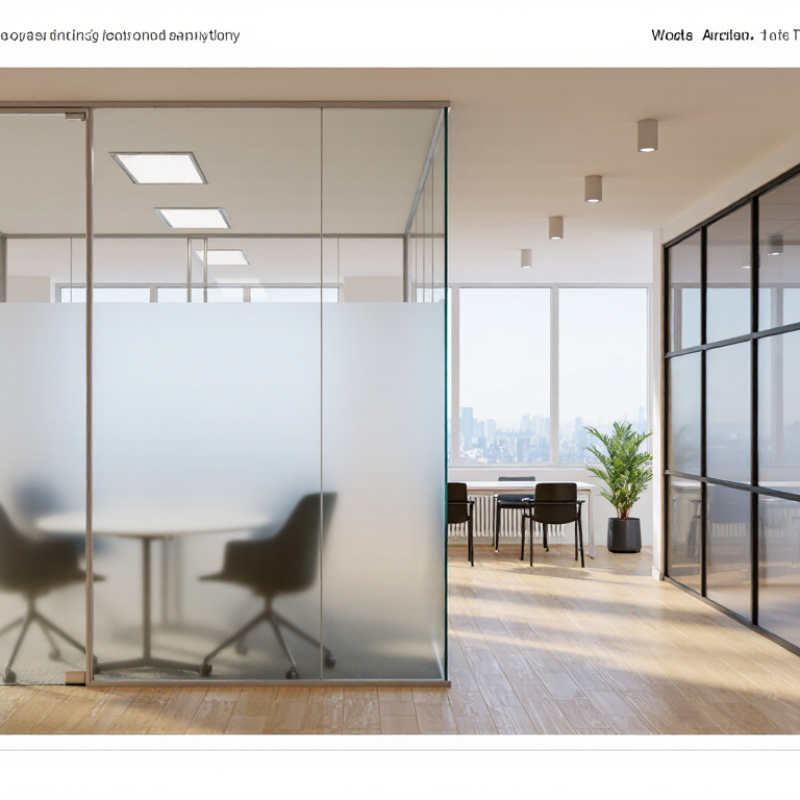
Frosted and patterned glass can soften sightlines without turning a room into a dark box. Frosted surfaces scatter incoming light, so a meeting room may stay bright while faces and details become indistinct. Patterned glass offers a different balance: fluted lines, fine reeding, or geometric textures obscure views while creating changing bands of light across the floor. Light still travels.
The level of privacy depends on the pattern, viewing angle, and lighting. At night, a brightly lit room may reveal more silhouettes than expected, especially when the surrounding area is dark. That matters. For sensitive conversations, pair decorative glass with blinds or choose a denser treatment rather than assuming texture guarantees privacy. A sample viewed upright beside a window can look different from a full-height panel installed across a room, so check it in the actual space if possible. Cleaning also deserves thought: deep grooves collect dust, while very fine patterns can show fingerprints. The trade-off is real. Some designs soften visibility beautifully but make shapes harder to recognize on the other side, which may not suit every doorway or shared workspace.
Partition Glass: Daylight Transmission by Type
Typical visible light transmission ranges (%) vary by glass thickness, pattern, and finish.
Frosted and patterned glass diffuse light while obscuring clear views. Actual transmission and privacy vary by product; confirm specifications with the glass supplier.
Acoustic Glass Partitions: STC Ratings Measured Under ASTM E90 and E413
Acoustic Glass Partitions are often compared by their Sound Transmission Class, or STC, rating. The rating comes from laboratory sound-transmission data measured under ASTM E90, then classified using ASTM E413. E90 tests an assembled partition between two rooms, measuring how much airborne sound passes through at different frequencies. E413 turns those results into one rating, making products easier to compare. It is not a promise of silence.
For example, a partition rated STC 40 may reduce ordinary speech more effectively than one rated STC 35. Small gaps matter. Sound can leak around door seals, through ceiling voids, or at poorly sealed floor tracks. In practice, the frame, glass joints, and adjacent construction all influence performance. Sound finds edges. A carefully specified glass build-up can still disappoint if the installation is rushed.
STC is most useful for comparing speech-range sound, such as conversation in an office. It does not describe every sound equally well; bass notes and structure-borne noise can behave differently. That is the catch. Treat the rating as a laboratory benchmark, then check the complete partition assembly and site details. I would also ask whether the tested configuration matches the proposed one. That question is easy to overlook.
Fire-Rated Glass: Common 20–120-Minute Ratings Under ASTM E119
Fire-rated glass partitions are tested as complete assemblies, not as loose panes. Under ASTM E119, the glazing, frame, seals, anchors, and installation details all affect the result. Common ratings include 20, 45, 60, 90, and 120 minutes. The rating describes performance during a controlled fire test; it does not guarantee identical results in every building.
Details matter. A narrow gap at the frame can undermine an otherwise suitable system. A 60-minute label is not a universal promise. NFPA’s Fire Loss in the United States During 2023 estimated 1.389 million fires and $23.2 billion in direct property damage nationwide. Those figures cover many kinds of fires, not partition failures, but they underline why tested fire barriers deserve careful specification. When comparing products, check the listed assembly, permitted glass dimensions, frame type, and installation instructions. Fire-protective glazing limits flames and smoke; fire-resistive systems may also restrict heat transfer. The distinction is easy to miss, and the correct choice depends on the project’s code requirements. One more check. Confirm the rating applies to the actual wall configuration, not just the glass sample.
| Fire-Rating Range | Common Glass Type | Typical Test or Rating Basis | Typical Partition Use and Performance | Important Qualification |
|---|---|---|---|---|
| 20 minutes | Listed fire-protection glazing, commonly specialty glass-ceramic or other tested glazing | Often tested to a glazing standard such as NFPA 257 or UL 9; the applicable standard depends on the product and assembly. | May be used in approved vision panels or partition openings where the building code permits fire-protection-rated glazing. | A 20-minute glazing rating should not automatically be described as an ASTM E119 wall rating. Verify the tested assembly and code approval. |
| 45 minutes | Listed fire-protection glazing in a compatible frame | Commonly supported by a fire-protection glazing test and listing; some specific systems may have other approved test documentation. | Used for certain rated openings and glazed partitions, subject to limits on location, area, and application. | Fire-protection glazing can resist flame and hot gases but may not provide the same limitation on heat transfer as fire-resistive glazing. |
| 60 minutes | Fire-resistive multi-layer glazing or another listed fire-resistive glazing system | Where classified as a fire-resistance-rated assembly, the complete system may be tested to ASTM E119 or UL 263. | Can be used in interior glazed partitions when the listed glass, framing, seals, and installation details match the approved system. | The rating applies to the tested assembly, not to the glass pane in isolation. Check whether the required criteria include limiting heat transfer. |
| 90 minutes | Fire-resistive glazing system with tested glass and framing components | Typically requires an assembly-specific fire-resistance classification, such as one based on ASTM E119 or UL 263. | May serve as a glazed section of a higher-rated interior separation where the applicable code and listing allow it. | Maximum sizes, framing configurations, support conditions, and permitted applications are system-specific. |
| 120 minutes | Specially engineered, listed fire-resistive glazing assembly | Requires evidence that the complete assembly has achieved the stated rating under the applicable fire-resistance test and listing. | Used in selected applications requiring a long-duration fire-resistance-rated glazed barrier. | A 120-minute rating is not a general property of all fire-rated glass; confirm the exact assembly classification and code acceptance. |
| Not fire-rated by type alone | Ordinary tempered, laminated, wired, or annealed glass | No fire-rating basis unless the specific glazing and framing system has been tested and listed for that rating. | Suitable for standard partitions when fire-rated construction is not required. | Glass composition alone does not establish an ASTM E119 rating. Use the tested glazing, frame, seals, and installation as a complete system. |
Article Source:
Let's Build Together
Contact Us: Call 435-563-3503
-OR- Fill in the form below and we will call you back.