Top Gas Cylinder Transportation Frame Manufacturers Worldwide

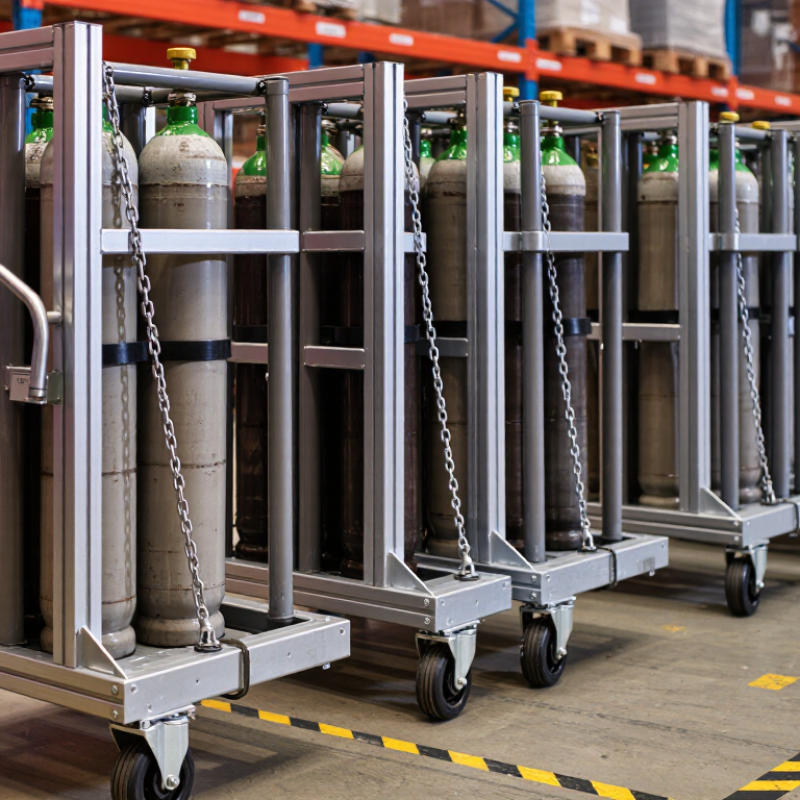
Choosing reliable equipment begins with understanding how gas cylinders move, rest, and remain protected during handling. A Gas Cylinder Transportation Frame must support safe loading, stable positioning, and practical movement across warehouses, workshops, hospitals, and industrial sites. Small design details matter. Wheel quality, weld consistency, frame balance, and cylinder restraints can affect daily performance.

This guide examines leading Gas Cylinder Transportation Frame manufacturers worldwide. It considers manufacturing experience, product range, material selection, testing practices, and customer support. Established manufacturers often provide steel or aluminum frames, reinforced bases, adjustable chains, and corrosion-resistant finishes. Some also offer custom dimensions for different cylinder sizes and transport environments. These features should be verified, not assumed.

The market is not perfectly uniform. A strong brochure does not always prove dependable field performance. We therefore encourage buyers to review technical drawings, load ratings, inspection records, and applicable regional requirements. Feedback from technicians can reveal practical weaknesses, such as difficult wheel replacement or awkward loading angles. No supplier is ideal. Details matter.

The manufacturers discussed here are evaluated through a professional and evidence-based perspective. Their capabilities, certifications, production history, and after-sales responsiveness deserve close attention. Readers should confirm current documentation directly with each supplier before making a purchase. This approach supports safer decisions, clearer comparisons, and better long-term value.
Top Gas Cylinder Transportation Frame Manufacturers Worldwide

Gas Cylinder Transport Frames: Purpose, Designs, and Load-Capacity Terms

Gas cylinder transport frames protect cylinders during lifting, movement, and temporary staging. Their design usually includes a welded steel base, vertical retaining bars, chain restraints, and forklift pockets. A four-cylinder frame may suit workshop deliveries, while larger bundles require stronger cross-bracing and certified lifting points. Stability matters more than appearance.

Load-capacity language needs careful reading. Tare weight means the empty frame and cylinder weight. Payload means the gas and cylinder load carried inside. Working Load Limit, or WLL, is the permitted service load. Safe Working Load, or SWL, may describe the same value, but terminology differs between suppliers. Verify the definition. Never assume “capacity” means gas volume.

ISO 11120 covers refillable seamless steel tubes above 150 litres, including common 250- and 300-bar working-pressure designs. A 47-litre water-capacity cylinder at 200 bar can contain roughly 9.4 cubic metres of gas, before temperature corrections. That number is useful, but imperfect. Actual mass depends on gas type, filling conditions, and cylinder tare. The IEA’s Global Hydrogen Review 2024 reported about 0.6 million tonnes of low-emissions hydrogen production in 2023, showing why reliable cylinder logistics remain important. Field inspections often find loose chains, damaged pockets, or unreadable load plates. These details can defeat an otherwise sound frame. Check center of gravity, restraint tension, inspection records, and floor loading before dispatch.

ISO 11120 Scope: Seamless Steel Tubes from 150 to 3,000 L Capacity

Top Gas Cylinder Transportation Frame Manufacturers Worldwide

For ISO 11120 applications, manufacturers must understand seamless steel tubes from 150 to 3,000 L water capacity. These large tubes store compressed gases and require controlled design, fabrication, and inspection. A reliable transportation frame should support the tube without creating local stress. It also needs secure restraints, balanced lifting points, and suitable protection against impact and corrosion.

Experienced manufacturers usually provide material certificates, weld inspection records, pressure-test documentation, and dimensional reports. They should explain how the frame matches tube diameter, length, valve protection, and loading equipment. ISO 11120 compliance does not automatically confirm every frame detail. The cylinder and its transport structure require separate technical evaluation. Small gaps in drawings can cause costly problems during loading. That deserves attention.

Tips: Check traceability from steel batch to finished assembly. Ask for lifting and restraint calculations. Inspect weld profiles, drain paths, coating quality, and access for routine checks. Confirm whether the frame suits road, rail, or container handling. Do not judge quality by paint alone. A clean surface may hide weak weld preparation or poor drainage. Site trials are valuable, although they are sometimes overlooked when delivery schedules become tight.

Top Gas Cylinder Transportation Frame Manufacturers Worldwide - ISO 11120 Scope: Seamless Steel Tubes from 150 to 3,000 L Capacity

Manufacturing Region Common Tube Arrangement Nominal Water Capacity per Tube Typical Frame Aggregate Capacity Approximate Frame Envelope Typical Gas Applications Key Compliance References Typical Transport Features
East Asia 1 × 150 L or 1 × 300 L seamless steel tube 150–300 L 150–300 L Approximately 1.2–2.0 m long × 0.8–1.1 m wide × 1.5–2.0 m high Nitrogen, oxygen, argon, helium, hydrogen and other compressed gases ISO 11120; applicable national pressure-equipment and transport regulations Forklift pockets, lifting lugs, protective corner posts and removable valve guards
South Asia 2 × 300 L or 4 × 300 L tubes 300 L 600–1,200 L Approximately 2.0–3.2 m long × 1.1–1.4 m wide × 1.6–2.2 m high Industrial gases, medical oxygen, calibration gases and process gases ISO 11120; ISO 9809 material and manufacturing practices may apply to relevant cylinders; local transport rules Cross-bracing, tube saddles, anti-roll restraints, grounding points and bottom forklift openings
Europe 4 × 300 L or 6 × 300 L tubes 300 L 1,200–1,800 L Approximately 2.4–3.6 m long × 1.2–1.5 m wide × 1.7–2.3 m high Oxygen, nitrogen, argon, hydrogen, carbon dioxide and specialty gases ISO 11120; ADR requirements for road transport; applicable EN and national pressure-equipment rules Documented load restraint, corrosion-protected steelwork, marked lifting points and impact protection
North America 4 × 300 L, 6 × 300 L or 8 × 300 L tubes 300 L 1,200–2,400 L Approximately 2.4–4.0 m long × 1.2–1.6 m wide × 1.7–2.4 m high Bulk industrial gases, hydrogen, inert gases and high-purity gas service ISO 11120 where applicable; national pressure-vessel, hazardous-material and highway-transport requirements Heavy-duty base rails, standardized lifting pockets, valve manifolds and transport tie-down locations
Middle East 6 × 300 L or 8 × 300 L tubes 300 L 1,800–2,400 L Approximately 3.0–4.0 m long × 1.2–1.6 m wide × 1.8–2.4 m high Hydrogen, nitrogen, oxygen, argon and refinery or petrochemical gases ISO 11120; applicable national pressure-equipment, road and port-handling regulations UV-resistant coatings, sealed drainage details, reinforced lifting lugs and high-temperature paint systems
Southeast Asia 8 × 300 L or 10 × 300 L tubes 300 L 2,400–3,000 L Approximately 3.2–4.5 m long × 1.2–1.6 m wide × 1.8–2.5 m high Industrial, medical and electronics-grade compressed gases ISO 11120; applicable maritime, road and local pressure-vessel requirements Drainage openings, anti-corrosion coating, modular manifolds and container-compatible lifting geometry
Oceania 2 × 300 L, 4 × 300 L or 6 × 300 L tubes 300 L 600–1,800 L Approximately 2.0–3.6 m long × 1.1–1.5 m wide × 1.6–2.3 m high Mining, healthcare, welding, water-treatment and laboratory gases ISO 11120; applicable Australian and New Zealand gas-cylinder and dangerous-goods requirements High-visibility markings, forklift access, weather-resistant finish and certified load-securing points
Technical note: ISO 11120 applies to transportable, refillable seamless steel tubes for compressed gases with a water capacity exceeding 150 L and up to and including 3,000 L. Frame dimensions are indicative ranges only; actual measurements vary with tube diameter, tube length, working pressure, manifold design, valve protection and local transport regulations. The aggregate frame capacity is calculated from the nominal water capacity of the individual tubes.

UN Model Regulations P200: Packaging, Securing, and Cylinder-Handling Controls

Top Gas Cylinder Transportation Frame Manufacturers Worldwide

UN Model Regulations P200 places packaging, securing, and handling at the center of safe gas-cylinder transport. Frames should hold each cylinder firmly, prevent valve contact, and resist movement during braking or vibration. A competent inspection should confirm that restraints remain effective when cylinders are full, empty, or unevenly loaded. Small gaps matter. They can become dangerous movement.

The International Energy Agency’s Global Hydrogen Review 2024 reported global hydrogen demand at about 97 million tonnes in 2023. This growth increases pressure on cylinder logistics and frame quality. Manufacturers should therefore document load ratings, material strength, corrosion resistance, and compatibility with the transported gas. P200 also requires attention to cylinder condition, valve protection, pressure limits, and applicable periodic inspections. A frame is not a substitute for compliant cylinders or trained handlers.

UNCTAD’s Review of Maritime Transport 2024 states that more than 80% of global merchandise trade by volume moves by sea. Frames may face lifting shocks, salt exposure, and repeated transfers before delivery. Practical designs need visible lifting points, stable bases, and restraint systems that workers can operate without awkward force. However, frame testing is sometimes treated as a final paperwork exercise. That is a weakness. Field inspections, recorded maintenance, and route-specific handling trials provide stronger evidence of reliability. Suppliers should also explain how their design supports P200 controls across road, rail, and sea interfaces.

Worldwide Manufacturer Map: China, Europe, North America, and India

China remains a major manufacturing center for gas cylinder transportation frames, supported by broad metalworking capacity and export experience. Factories commonly provide welded steel frames, forklift pockets, lifting points, and adjustable restraints. Practical buyers should inspect weld consistency, coating thickness, and documentation before comparing prices.

Europe places stronger emphasis on traceability, ergonomics, and regional transport requirements. Manufacturers often refine frames for compact vehicle loading, corrosion resistance, and safer manual handling. Design reviews may include load testing, dimensional checks, and clear identification plates. Small details matter here. A poorly positioned latch can slow loading and increase handling risk.

North American production often favors rugged frames for warehouses, service vehicles, and uneven outdoor yards. Heavy tubing, reinforced bases, and accessible tie-down points are common priorities. India is expanding its fabrication capability, with competitive production and growing attention to export-quality inspection. However, consistency can vary between workshops.

A map can mislead. The strongest supplier is not always in the largest market. Buyers should verify material certificates, test records, packaging methods, and after-sales communication. Regional standards also differ, so a frame accepted in one country may require modification elsewhere. Experienced procurement teams usually request a sample, review drawings, and perform a practical fit test before approving volume production.

Manufacturer Evaluation: Testing, Certification, Traceability, and Lead Times

Selecting a gas cylinder transportation frame manufacturer requires more than comparing prices or polished catalogs. Testing records reveal how a frame performs under real handling conditions. Ask for documented load tests, weld inspections, impact checks, and corrosion assessments. A serious manufacturer should explain test methods clearly, not hide behind vague claims.

Certification must match the destination market and the frame’s intended use. Review certificates, inspection dates, laboratory details, and applicable technical standards. Traceability is equally important. Each frame should carry a durable identification plate linked to material certificates, weld records, inspection results, and production batches. A readable serial number matters when a damaged frame returns for investigation.

Lead times deserve practical scrutiny. Request a production schedule showing design approval, material purchasing, fabrication, coating, final inspection, and dispatch. Confirm whether replacement parts follow the same traceability process. A missed shipment can disrupt cylinder handling operations, but rushed fabrication can create greater risks. No factory is flawless. One weld may need rework, or a coating batch may fail inspection. Reliable manufacturers report such issues openly and explain the corrective action. Buyers should also check packaging details, storage conditions, and communication during delays. A useful evaluation is not only about what the manufacturer promises, but what its records can prove.

Let's Build Together

Contact Us: Call 435-563-3503

-OR-  Fill in the form below and we will call you back.

Copyright © 2025CNC Fabrication. All Rights Reserved.