
10 Hazardous Area Lighting Tips for Global Buyers
Hazardous Area Lighting is more than a brightness decision. In facilities handling flammable gases, combustible dust, or corrosive materials, the wrong fixture can create serious safety and maintenance concerns. A product’s appearance or wattage alone cannot show whether it suits a specific location. Buyers need to examine the hazardous-area classification, operating temperature, ingress protection, mounting position, and expected maintenance conditions. Small details matter. A cable entry exposed to moisture, for example, may affect long-term reliability.
Global purchasing adds another layer of complexity. Product markings, certification documents, installation practices, and local requirements can differ between markets. Do not assume that one approval automatically applies everywhere. Ask suppliers for current, traceable documentation, and have qualified professionals confirm suitability for the intended site. This guide presents ten practical checks to help buyers compare products and suppliers with greater confidence. It covers light output, materials, temperature performance, controls, installation, service access, and documentation. A checklist cannot replace a site assessment. It can, however, help reveal gaps before an order is placed.
Some trade-offs deserve a second look. A lower purchase price may come with harder maintenance or limited parts availability. Conversely, a premium specification may not deliver value if the fixture exceeds actual site needs. These tips are intended to support careful questions, not promise a universal solution. The right choice depends on the environment, project requirements, and verified product information.
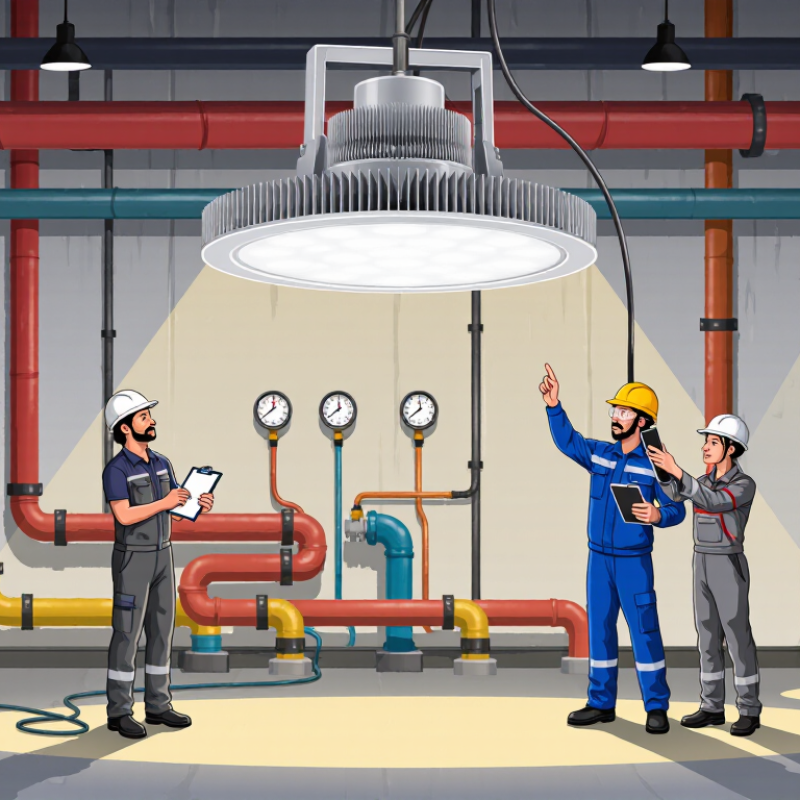
Understanding Hazardous Area Classifications and Explosion Risks
Hazardous-area lighting starts with the atmosphere, not the fixture. A site may contain flammable gas, vapor, combustible dust, or a mixture. Each presents different ignition risks. Classification identifies where these materials may occur and how often. Small details matter. A dusty conveyor room, for example, may need a different assessment from a gas compressor enclosure.
Global buyers may encounter Class and Division descriptions or Zone classifications. These systems are related, but their terms and equipment markings are not interchangeable. Check the area classification drawings and confirm the gas or dust group, temperature class, and required protection method. The temperature class matters: a luminaire’s hot surface must not exceed the ignition threshold of the surrounding material. Do not guess. Ask a qualified site professional to verify the classification, especially when processes or ventilation have changed.
A certificate alone does not settle every purchasing question. Confirm that its scope matches the actual atmosphere, ambient temperature, and installation conditions. Dust can settle on a housing and reduce heat dissipation; moisture and cleaning chemicals can also affect materials. Check whether the required approval is accepted for the destination and installation. A neat comparison chart can still miss a site-specific hazard. Rechecking the documents against the real installation may feel repetitive, but it can prevent a costly mismatch.
10 Hazardous Area Lighting Tips for Global Buyers - Understanding Hazardous Area Classifications and Explosion Risks
| # | Buyer tip | What to understand or verify | Explosion risk addressed |
|---|---|---|---|
| 1 | Classify the area before choosing a fixture | Obtain the site’s hazardous-area classification from the responsible engineering or safety authority. Classification depends on the type of combustible material and how often it may be present. | A fixture not suited to the classified area may provide an ignition source where flammable gas, vapor, dust, or fibers are present. |
| 2 | Distinguish gas zones from dust zones | Under the IEC zone system, Zones 0, 1, and 2 relate to explosive gas atmospheres; Zones 20, 21, and 22 relate to combustible dust atmospheres. Confirm the zone specified for the actual location. | Using a gas-only rating where dust protection is required, or vice versa, can leave relevant ignition hazards unaddressed. |
| 3 | Do not treat zones and divisions as interchangeable | Some North American codes use Class, Division, and Group classifications. Division 1 and Division 2 are not direct, one-to-one equivalents of IEC Zones. Have the site’s classification assessed against the applicable local code. | Assuming unlike classification systems are interchangeable can lead to selection of equipment that does not meet local requirements. |
| 4 | Match the equipment to the gas or dust group | Check the material group on the site documentation and compare it with the equipment marking. Gas and dust grouping systems differ; a marking for one material group should not be assumed suitable for every other group. | The ignition characteristics of combustible materials vary, so an unsuitable equipment group may not provide the required protection. |
| 5 | Check the temperature class and maximum surface temperature | For common gas temperature classes, T1 through T6 correspond to maximum equipment surface temperatures of 450°C, 300°C, 200°C, 135°C, 100°C, and 85°C, respectively. Confirm that the permitted surface temperature is below the ignition temperature of the site’s material, considering ambient conditions. | A hot surface can ignite a flammable atmosphere even when the fixture’s electrical enclosure is otherwise suitably protected. |
| 6 | Verify the protection concept and equipment level | Read the complete marking and certificate documentation, including the protection method and any Equipment Protection Level (EPL) or equivalent designation. Confirm suitability for the classified location rather than relying on a single marking element. | The protection method and equipment level indicate how the product is intended to control ignition risks in its specified application. |
| 7 | Confirm approvals for the installation country | Check that the exact product, configuration, and certificate are accepted by the destination market and the project authority. ATEX, IECEx, and national approval schemes have different scopes and are not automatically interchangeable. | A product with a certificate that is not accepted for the project may be unsuitable for installation or operation at that site. |
| 8 | Review ambient temperature and environmental limits | Compare the marked ambient-temperature range with expected site conditions. Also check the enclosure’s ingress-protection rating, corrosion resistance, UV exposure, vibration, and any chemical or washdown exposure relevant to the installation. | Conditions outside the product’s certified or specified limits can impair its protective construction or raise operating temperatures. |
| 9 | Check dust accumulation and cleaning requirements | For dusty locations, review the equipment’s dust suitability, enclosure rating, installation instructions, and maintenance plan. Keep surfaces and cooling paths clear as required by the manufacturer and site procedures. | Accumulated combustible dust can contribute to fire or explosion hazards and may cause equipment to run hotter. |
| 10 | Treat installation and maintenance as part of the protection system | Use qualified personnel and follow the certified product instructions, applicable electrical codes, and site procedures. Verify cable entries, glands, seals, fasteners, grounding, and inspection requirements; do not modify certified equipment without authorization. | Incorrect installation, damaged seals, unsuitable cable entries, or unauthorized changes can compromise the equipment’s protection. |
Note: Hazardous-area selection depends on the site classification, applicable codes, and equipment certification. Confirm final suitability with the project’s qualified hazardous-area professional and the relevant local authority.
Let's Build Together
Contact Us: Call 435-563-3503
-OR- Fill in the form below and we will call you back.