How to Choose the Best Indoor Acoustic Wall Panels in 2026?

A hard wall can make a small room feel surprisingly loud. Voices bounce between glass, plaster, and desks, making calls harder to follow. An Indoor Acoustic Wall Panel can help, but choosing one by appearance alone is a common mistake. The right choice depends on the room, the noise problem, and how the panel performs.

Professional guidance offers useful reference points. ANSI/ASA S12.60 sets classroom reverberation-time limits of 0.6 seconds for rooms up to 10,000 cubic feet and 0.7 seconds for rooms up to 20,000 cubic feet. These figures apply to specific classroom conditions, not every home or office. ASTM C423 provides a laboratory method for measuring sound absorption, including the Noise Reduction Coefficient (NRC). That rating is useful, but it does not predict every room’s result. Installation, coverage, ceiling height, and furnishings also matter.

This guide explains how to compare panel materials, thicknesses, finishes, and test data in 2026. It also considers fire ratings, cleaning needs, and installation constraints—details that product photos often hide. Sound matters. A fabric-wrapped panel may suit a meeting room, while a moisture-tolerant finish may make more sense elsewhere. There is no perfect panel for every space, and acoustic improvements can be less dramatic than expected. Careful measurements and realistic goals help you choose with confidence.
How to Choose the Best Indoor Acoustic Wall Panels in 2026?

Understanding How Indoor Acoustic Wall Panels Work

Indoor acoustic wall panels manage reflections, not sound transmission. Their porous fibers or perforated faces let sound enter the material, where friction converts some acoustic energy into heat. Less reflected sound can make speech clearer and reduce the hollow, echoing feel of a room. But panels are not soundproof walls.

Look beyond appearance. ASTM C423 laboratory reports commonly show a Noise Reduction Coefficient (NRC), calculated from absorption measurements at 250, 500, 1,000, and 2,000 Hz. It is a useful comparison, not a promise of equal performance at every frequency. Low voices and bass may need thicker panels or an air gap behind them. Placement matters, too: a panel behind a talker may help, while a bare ceiling can still reflect speech across the room.

Room targets offer useful context. ANSI/ASA S12.60-2010/Part 1 (R2020) sets maximum reverberation times of 0.6 seconds for certain small core learning spaces and 0.7 seconds for larger ones. These are classroom criteria, not universal home targets. Real rooms differ. A tiled kitchen with a long echo needs a different treatment from a carpeted study. Measure or listen before buying; even careful estimates can miss a stubborn reflection.

Assessing Room Acoustics and Sound-Control Needs

Assess the room before selecting indoor acoustic wall panels. Stand near the center and listen for a sharp clap that lingers, speech that feels muddy, or a fluttering echo between parallel walls. A phone recording can help compare locations, but it is not a calibrated measurement. Note the room’s dimensions, ceiling height, floor finish, windows, and main activities. A small meeting room needs clearer speech; a media room may need a different balance.

For a more objective check, measure reverberation time (RT60) across several positions, ideally with acoustic testing equipment. ANSI/ASA S12.60-2010/Part 1 sets classroom reverberation limits of 0.6 seconds for core learning spaces up to 10,000 cubic feet, and 0.7 seconds for spaces from 10,000 to 20,000 cubic feet. These are classroom criteria, not universal targets. Identify reflective surfaces such as glass, tile, and bare plaster. Absorptive panels can reduce reflected sound, but they do not seal doors or block sound traveling through walls.

Tips: Take a baseline recording before installation, then repeat it from the same spot. Start with the wall facing the main sound source, and reassess before adding more panels. It is easy to over-treat a room; the result can feel strangely flat.

How to Choose the Best Indoor Acoustic Wall Panels in 2026? - Assessing Room Acoustics and Sound-Control Needs

Panel Type Typical Absorption Performance Best Suited For Key Selection Factors Limitations to Consider
Fabric-Wrapped Fiberglass or Mineral-Wool Panels Often achieves an NRC of about 0.80–1.00 in commonly tested thicknesses and mounting arrangements. Performance varies with thickness, density, and air gap. Offices, classrooms, meeting rooms, studios, and other spaces where reducing reverberation and reflections is a priority. Check the tested panel thickness, edge construction, fire-performance documentation, fabric cleanability, and installation method. A deeper panel or air gap can improve lower-frequency absorption. Primarily absorbs sound inside the room; it does not by itself provide sound isolation through walls. Fabric can be vulnerable to stains or damage in high-traffic areas.
PET-Felt Panels Performance varies substantially by thickness, pattern, backing, and mounting. Compare tested NRC values for the complete panel assembly rather than relying on material type alone. Offices, collaborative areas, corridors, and spaces that need lightweight panels or decorative shapes. Review the tested acoustic report, recycled-content claims, panel thickness, edge finish, attachment system, and cleaning instructions. Thin or highly patterned panels may absorb less sound than thicker absorptive assemblies. NRC alone does not describe performance at every frequency.
Wood-Slat Panels with Absorptive Backing Can provide useful absorption when slat spacing, backing, and cavity are designed as a tested system. Results vary considerably between constructions. Reception areas, conference rooms, dining spaces, and interiors where a timber finish is desired alongside reverberation control. Ask for test data for the exact slat spacing, backing material, and mounting cavity. Check finish durability, fire requirements, and access for maintenance. Decorative slats without suitable absorptive backing may reflect much of the sound. Do not assume that appearance or material alone indicates acoustic performance.
Perforated Wood Panels with Absorber Behind Absorption depends on perforation size and pattern, panel thickness, backing, and cavity depth; use the rating for the complete tested assembly. Rooms needing a durable, cleanable architectural surface, such as auditoriums, teaching spaces, and public interiors. Confirm the tested configuration, including perforations and cavity depth. Consider cleanability, edge details, fire documentation, and access to concealed services. A solid or incorrectly backed panel can remain largely reflective. Installation changes may alter performance from the tested result.
Acoustic Foam Panels Absorption varies with foam thickness, shape, and frequency. Request product-specific test data rather than comparing by profile or appearance. Some studios, practice rooms, or utility spaces where lightweight treatment is appropriate and the product meets applicable safety requirements. Check fire-performance documentation, emissions information where relevant, thickness, mounting method, and performance across the frequencies of concern. Foam is not automatically suitable for every occupied building. Thin foam may do little for low-frequency problems, and it does not block sound transmission between rooms.
Hybrid or Custom Panel Assemblies Can be tuned to a room's acoustic goals, but performance must be verified for the specific combination of face material, absorber, cavity, and mounting. Rooms with mixed needs, unusual dimensions, design constraints, or specific frequency-related acoustic problems. Define the room's use, target reverberation, available wall area, installation depth, and required test evidence before specifying a custom assembly. Custom designs may require more coordination and installation detail. Do not substitute materials or mounting methods without checking their effect on tested performance.

How to compare: NRC (Noise Reduction Coefficient) is a single-number rating based on absorption measurements at 250, 500, 1,000, and 2,000 Hz, rounded to the nearest 0.05. Treat it as a useful comparison, not a complete description of room performance. Ask for test data for the exact panel assembly and mounting condition, and assess low-frequency needs separately. Absorptive wall panels reduce reflections within a room; they are not a substitute for sound-isolating construction.

Comparing Panel Materials, Ratings, and Performance

How to Choose the Best Indoor Acoustic Wall Panels in 2026?

Comparing Panel Materials, Ratings, and Performance

A panel’s material matters, but its test data matters more. Soft, porous fiberglass and mineral-fiber panels often absorb sound effectively across speech frequencies; thin decorative foam may perform unevenly, especially at lower frequencies. Look for test reports using ASTM C423, the standard reverberation-room method. Its Noise Reduction Coefficient (NRC) averages absorption at 250, 500, 1,000, and 2,000 Hz, then rounds to the nearest 0.05. An NRC of 0.80 indicates strong average absorption in those bands, not soundproofing. It does not tell you how much sound passes through a wall.

Compare the frequency-by-frequency results, not just the headline rating. ISO 354 reports sound absorption by frequency, helping reveal whether a panel handles speech, bass, or both. Check the tested thickness, mounting method, and any air gap: a 50-millimeter panel mounted away from the wall may not match a thinner panel installed flush. Ask for the laboratory report, not only a product sheet. In a small meeting room, panels spaced across the reflection points can reduce echo; covering every wall is rarely necessary.

Still, ratings cannot predict every room. Furniture, ceiling height, and hard floors change what you hear. That part is messy.

Checking Safety, Design, Installation, and Maintenance

When choosing indoor acoustic wall panels, check safety documents before comparing colors. Ask for current fire-test results under ASTM E84; its Class A range is a flame-spread index of 0–25 and smoke-developed index of 0–450. Confirm the panel’s tested thickness and backing match the product being offered. Requirements vary by building and location. The details matter.

For absorption, look for ASTM C423 test data and the Noise Reduction Coefficient (NRC). An NRC of 0.80 indicates strong average absorption across the standard test frequencies, but it does not mean the panel blocks 80 percent of outside noise. The World Health Organization’s Night Noise Guidelines for Europe recommend 30 dB(A) indoors for continuous night noise; wall panels can reduce reflections, not guarantee that level.

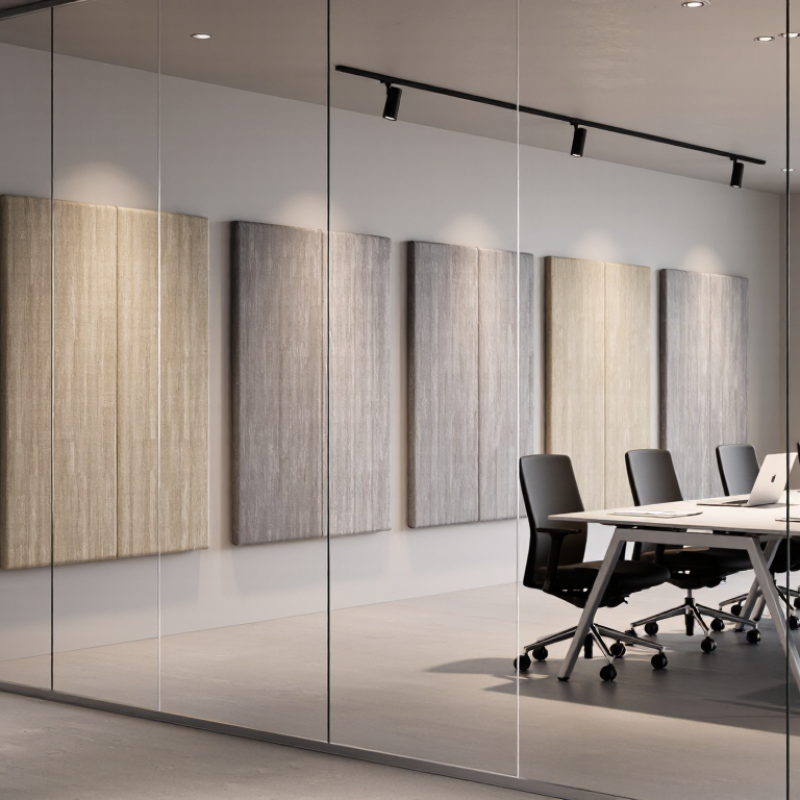
Design should serve the room, not only the photograph. A few panels around a meeting table may soften voices, while a bare glass wall still sends sound bouncing back. Check color consistency, edge finish, and cleanability against samples in the actual lighting. Installation matters, too: record the wall type, fixing method, and any required air gap, since these can affect performance. Small details matter.

Leave access to outlets and switches, and follow the tested installation instructions rather than improvising with heavy panels. For upkeep, use the maker’s stated cleaning method and inspect seams, fixings, and fabric for dust or loosening. Maintenance plans are easy to forget. I would also keep the test sheets and installation notes together; they make later repairs less of a guessing game.

Matching Panel Choices to Budget and Room Use

How to Choose the Best Indoor Acoustic Wall Panels in 2026?

Matching Panel Choices to Budget and Room Use

Start with the room’s actual problem. In a home office, speech reflections can make calls tiring; in a dining room, hard floors and bare walls may create a sharp echo. Measure the room and note its surfaces before comparing prices. For classrooms, ANSI/ASA S12.60-2010/Part 1 sets a 35 dBA background-noise limit and a 0.6-second reverberation-time benchmark for smaller rooms. These figures are useful reference points, not a promise that wall panels alone will meet them. A small, well-placed treatment may help more than covering every wall with low-cost foam.

Tips: Match the panel’s tested absorption rating to the frequencies causing trouble, and check fire and installation specifications. For a budget-conscious upgrade, begin at first-reflection points near desks or seating. A meeting room may need broader coverage, while a bedroom often needs less. Leave space for doors, vents, and artwork. Small rooms differ.

Higher-density fabric-wrapped panels can suit busy shared spaces, but the extra cost may be unnecessary in a quiet study. Ask for test data, such as absorption coefficients measured under ASTM C423, and compare products using the same test method. Also check panel thickness and mounting method; both affect performance. I would not choose by appearance alone. I’ve seen attractive panels placed where they barely changed the echo, and that is an easy mistake to repeat.

Let's Build Together

Contact Us: Call 435-563-3503

-OR-  Fill in the form below and we will call you back.

Copyright © 2025CNC Fabrication. All Rights Reserved.