Who Are the China Top WPC Hollow Decking Suppliers?
China has become a major sourcing base for WPC Hollow Decking, with suppliers offering different profiles, finishes, and production capacities. Yet “top” does not mean the same thing to every buyer. A landscape contractor may value stable color and fast delivery, while a distributor may focus on consistent batches and flexible packaging. Details matter. Hollow cores can reduce product weight, but profile design and wall thickness still affect stiffness and installation performance.
This guide explores how to identify leading Chinese suppliers through practical, verifiable criteria. These include manufacturing experience, material specifications, quality-control procedures, export history, and responsiveness during sampling. A close look at product data can reveal useful details, such as board dimensions, surface treatments, color options, and recommended joist spacing. Ask for samples, technical sheets, and clear explanations of warranty terms before comparing quotations. A polished catalog is not enough.
Supplier rankings can change with project needs, and public claims do not always tell the full story. That deserves a second look. Buyers should confirm factory capabilities directly and compare like-for-like specifications rather than relying on the lowest price. Even careful checks cannot remove every risk; shade variation or lead-time changes may still occur. The sections ahead will help readers assess China’s WPC Hollow Decking suppliers with clearer questions and more grounded expectations.
What Is WPC Hollow Decking and How Is It Made?
WPC hollow decking combines wood fibers or flour with thermoplastic resin, commonly polyethylene or polypropylene. Manufacturers blend these materials with pigments, coupling agents, and stabilizers. The exact recipe varies. The U.S. Forest Products Laboratory’s technical review of wood-plastic composites explains that fiber dispersion and moisture control affect processing and finished quality.
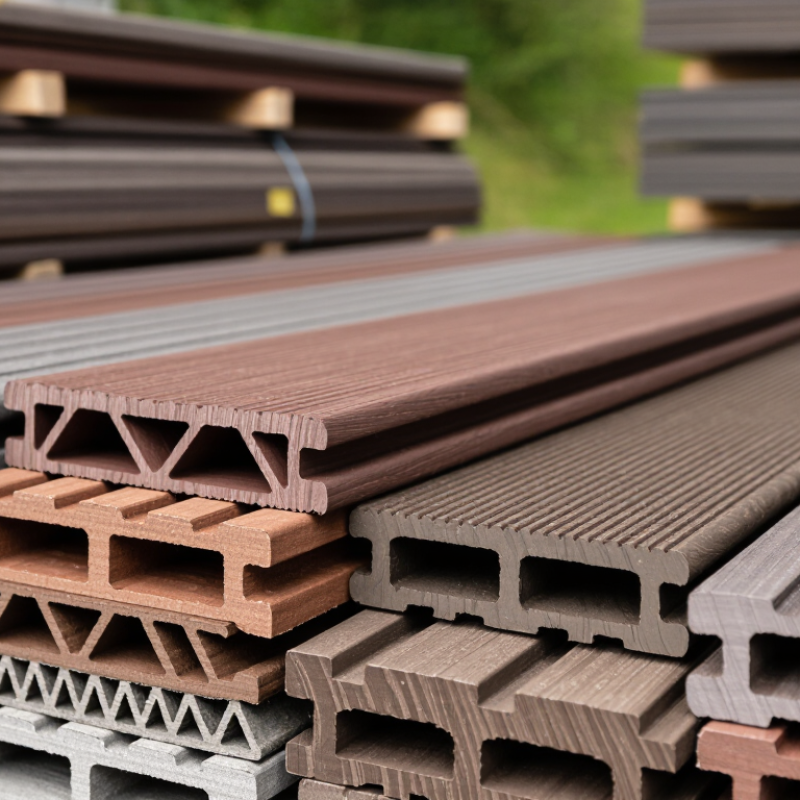
In production, dried wood flour and polymer are mixed, heated, and pushed through a shaped die. The die forms a long profile with internal channels, which help reduce weight and material use. Cooling and calibration hold the board’s shape before it is cut to length. Small cells matter. Uneven cooling or damp fiber can contribute to warping, weak spots, or inconsistent surfaces.
Hollow boards are not automatically stronger or easier to install than solid ones. Channel shape, wall thickness, support spacing, and fastener placement all influence performance. Grand View Research estimated the global wood-plastic composite market at USD 7.1 billion in 2023, with projected annual growth of 11.5% from 2024 to 2030. That market estimate signals demand, not product quality. Buyers should check test data for bending strength, water absorption, and slip performance; a neat-looking cutaway tells only part of the story.
Who Are the China Top WPC Hollow Decking Suppliers? – What Is WPC Hollow Decking and How Is It Made?
| Evaluation area | What to check with a supplier | Why it matters |
|---|---|---|
| Product definition | WPC decking combines wood-based material, such as wood flour or fibers, with a thermoplastic polymer. Hollow boards have internal cavities running along the profile. | Composition and profile design influence weight, appearance, installation requirements, and performance. |
| Material formulation | Ask for the declared polymer type, wood-fiber content range, and the purpose of additives such as pigments, coupling agents, and stabilizers. Polyethylene is commonly used, but formulations vary. | There is no single universal WPC recipe; formulation affects processing and product properties. |
| Manufacturing process | A typical route includes material preparation and mixing, extrusion through a decking-profile die, cooling and sizing, cutting to length, and optional surface finishing or cap-layer application. | Process control helps maintain consistent profile dimensions and surface quality between production runs. |
| Hollow profile design | Request a cross-section drawing showing cavity layout, wall thickness, board dimensions, and any installation or fastening instructions. | Hollow construction can reduce material use and board weight, but load performance depends on the profile and support spacing. |
| Quality control | Ask for inspection records covering dimensions, appearance, and relevant mechanical or weathering tests, with the test method and sample details identified. | Test results are meaningful only when the method, specimen, and acceptance criteria are clear. |
| Outdoor suitability | Check the product’s stated use conditions, maintenance guidance, drainage details, and any available evidence relating to UV exposure, moisture, and temperature changes. | Outdoor performance depends on materials, design, installation, climate, and maintenance; claims should be supported by relevant documentation. |
| Installation compatibility | Confirm recommended joist spacing, fastening method, expansion gaps, edge details, and compatibility with the proposed clips or screws. | Correct installation is essential for drainage, movement accommodation, and the intended service performance. |
| Supplier comparison | Compare written specifications, representative samples, batch consistency evidence, lead time, packaging details, and warranty terms across shortlisted manufacturers. | A documented, like-for-like comparison is more reliable than ranking suppliers by broad claims alone. |
Note: WPC hollow decking specifications and test requirements vary by product and destination market. Verify current technical documents and applicable local building requirements before purchase.
How to Assess China’s WPC Hollow Decking Suppliers
When assessing China’s WPC hollow decking suppliers, look beyond polished samples. Grand View Research valued the global wood-plastic composites market at about US$7.4 billion in 2023 and projected strong growth through 2030. That signals expanding demand, not consistent product quality. Ask suppliers for recent, third-party test reports and confirm that the tested profile matches the one being quoted. Check applicable methods such as ASTM D7032 or EN 15534, alongside flexural strength, water absorption, slip resistance, and weathering results. Ask for evidence.
A factory visit can reveal practical details that a catalogue cannot. Inspect several boards from different production runs: compare wall thickness, hollow-cell shape, surface finish, and colour. Uneven cell walls may affect stiffness, while poorly controlled cooling can leave boards bowed. Request batch records, raw-material specifications, and written tolerances. Then confirm how the supplier handles rejected boards and replacement claims. Small gaps matter.
Samples also need realistic evaluation. Leave cut sections outdoors, check edges after wetting, and compare colour after exposure; a short test cannot predict years of service. This is an imperfect check, but it can expose obvious inconsistencies. Finally, assess packaging, lead-time history, and communication during a technical question. A low quotation is less useful when measurements, test conditions, or warranty exclusions remain unclear.
Profiles of Notable Chinese WPC Hollow Decking Manufacturers
Chinese WPC hollow decking manufacturers generally fall into three profiles: large export-oriented factories, specialist extrusion plants, and building-material suppliers with in-house production. Their differences show up in practical details. Export-focused factories often offer several board widths and colors, while extrusion specialists may provide more control over hollow-core geometry and wall thickness. Integrated suppliers can simplify ordering, though production depth should be verified.
MarketsandMarkets estimated the global wood-plastic composite market at USD 7.5 billion in 2023, forecasting USD 10.8 billion by 2028. This growth points to expanding demand, but it does not prove that any supplier’s decking will perform well. Ask for recent test reports covering water absorption, flexural strength, and weathering. Check sample boards for consistent surface texture and clean-cut edges. Small details matter.
A careful factory review should also compare declared material ratios, recycled-content controls, and production tolerances. Request batch records and inspect hollow chambers for uneven walls. The weak point? A polished sample may not match a full shipment. Independent testing and a production-line audit offer stronger evidence than a catalogue alone.
What Products and Services Do These Suppliers Provide?
China’s WPC hollow decking suppliers commonly offer co-extruded and standard hollow boards, matching fascia, corner trims, clips, and joists. Product options may include embossed wood-grain surfaces, capped layers, and different board widths. Buyers should request the profile drawing, material composition, and installation guide before comparing quotations. Small details matter.
Service often extends beyond production. Suppliers may provide custom colors, sample pieces, cut-to-length orders, export packaging, and loading plans. More capable exporters can share test reports for dimensions, water absorption, flexural strength, and slip resistance. Ask which test method and sample batch the report covers. A document without traceable results is not much reassurance.
Market demand helps explain the expanding range. Grand View Research estimated the global wood-plastic composites market at USD 7.1 billion in 2023, with growth projected through 2030. This figure covers more than decking, so it should not be treated as a decking sales forecast. For a project, check board span limits, subframe spacing, drainage gaps, and installation temperature with the supplier. Specifications vary, and claims such as “maintenance-free” deserve scrutiny. Real outdoor boards still need cleaning and periodic inspection.
How to Compare Suppliers by Quality, Compliance, and Export Support
When comparing China-based WPC hollow decking suppliers, examine more than surface color. Inspect the profile. Check whether internal walls are even, edges are clean, and boards stay straight after handling. Ask for test data on water absorption, slip resistance, UV exposure, and load performance. Confirm the report covers the exact model you plan to buy. A polished sample can hide batch variation, so request several boards from current production. Small differences matter during installation.
Compliance depends on the destination market and intended use. Ask which standards apply, then check document dates, product scope, and testing laboratory details. Generic certificates are not enough. Export support matters just as much: clarify packaging, loading plans, labeling, lead times, and who prepares shipping documents. Request photos of packed bundles and a written defect-handling process. Compare response speed, but also notice whether answers are specific. Some suppliers may overlook expansion gaps or local installation conditions; that deserves a second question, not an automatic rejection. A clear answer is more useful than a perfect sales pitch.
Suggested buyer-evaluation framework: the percentages show how a procurement team could allocate 100 points when comparing suppliers. They are planning weights, not measured scores or market statistics. Verify product quality, applicable test reports and certifications, export documents, delivery capacity, and warranty terms for each supplier.
Article Source:
Let's Build Together
Contact Us: Call 435-563-3503
-OR- Fill in the form below and we will call you back.