
Who Are the Best Welding Tube Manufacturers in China?
Choosing the best Welding Tube manufacturer in China takes more than comparing prices or browsing polished factory photos. Buyers need to examine the production process, material traceability, dimensional control, and testing records. A clean weld bead is encouraging, but it cannot prove consistent wall thickness or reliable performance across a full shipment.
For transparency, the expert voice below is fictional and illustrative, not a sourced quotation. Lin Wei, a composite welding-tube quality specialist, offers this buyer-focused principle: “A dependable tube is proven by repeatable measurements, not by one impressive sample.” That distinction matters. Ask how the manufacturer controls weld alignment, checks outside diameter, and documents inspection results. When possible, review sample reports and confirm that the quoted specification matches your application.
Details matter. A tube intended for a demanding industrial assembly may require different materials, tolerances, and verification than one used in a general fabrication project. Strong manufacturers explain those differences clearly. They also answer practical questions about production capacity, lead times, packaging, and corrective actions when a batch misses specification.
This guide compares Chinese suppliers through criteria buyers can verify, rather than unsupported claims of a single universal winner. No shortlist can replace careful qualification. Even a well-presented supplier may leave questions unanswered, and that is worth noticing. The right partner is the one whose documented capabilities fit your requirements—and remain consistent after the first order.
What Are Welded Tubes and How Are They Manufactured?
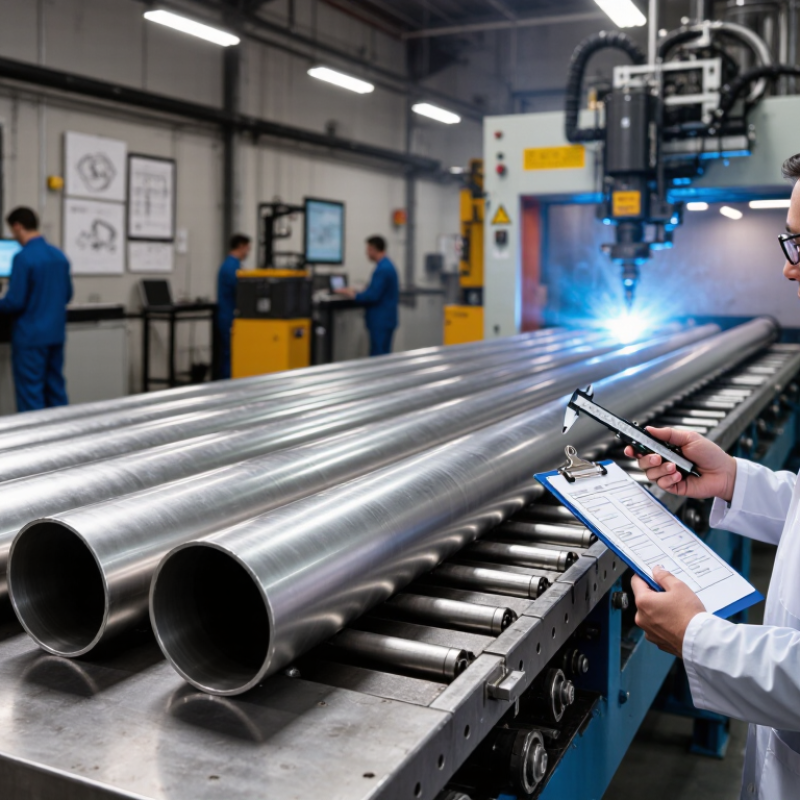
Welded tubes are hollow metal sections formed from flat strip or coil. Unlike seamless tubes, they retain a longitudinal seam where the edges meet. Common materials include carbon steel and stainless steel, selected according to strength, corrosion resistance, and the working environment. The finished tube may be round, square, or rectangular.
Manufacturing begins with slitting the coil to the required width. Forming rolls gradually bend the strip into a circular shape, bringing its edges together. High-frequency electric resistance welding is commonly used to join them without added filler metal. The weld flash may be removed, and sizing rolls help control the final diameter and shape. Then the tube is cut to length. Simple steps, but not effortless.
Depending on the application, manufacturers may apply heat treatment or additional finishing. Inspection can include dimensional checks, visual examination, and nondestructive testing of the seam. These checks matter: uneven wall thickness or a poor weld can affect fit and service life. No process is flawless. Specifications and inspection methods vary, so buyers should match them to the tube’s intended use rather than assume every welded tube is made to the same standard.
Who Are the Best Welding Tube Manufacturers in China? - What Are Welded Tubes and How Are They Manufactured?
| Tube Type or Evaluation Area | How It Is Made | Common Materials and Uses | What to Check When Comparing Manufacturers | Relevant Standards or Tests |
|---|---|---|---|---|
| High-frequency ERW tube | Flat steel strip is formed into a round shape. High-frequency electrical current heats the strip edges, which are pressed together to create a longitudinal weld; the weld bead may then be removed. | Commonly produced from carbon or low-alloy steel. Used in structural frameworks, furniture, fencing, and general engineering. | Review dimensional tolerances, weld consistency, surface condition, available sizes, and whether the product meets the intended application’s requirements. | ASTM A513 covers certain carbon and alloy steel mechanical tubing; ASTM A500 covers cold-formed welded and seamless carbon steel structural tubing. Applicability depends on the product and specification. |
| Longitudinal TIG-welded stainless tube | Stainless steel strip is formed into a tube and its longitudinal seam is welded using gas tungsten arc welding (GTAW/TIG). Some products receive subsequent sizing or finishing. | Common grades include austenitic stainless steels such as 304 and 316. Used in food-processing equipment, architectural work, and corrosion-resistant applications. | Confirm the specified grade, wall thickness, weld finish, surface finish, corrosion requirements, and whether testing is suitable for the service conditions. | ASTM A554 covers welded stainless steel mechanical tubing. ASTM A312 applies to certain welded, heavily cold-worked, and seamless stainless steel pipe—not to every stainless tube product. |
| Laser-welded tube | Formed strip edges are joined with a focused laser beam. The process can produce a narrow weld zone and is often used for precision or thin-wall products. | Depending on the production line, materials can include stainless steel and other weldable metals. Applications include automotive components, furniture, and precision assemblies. | Ask for evidence of process control, weld inspection, dimensional capability, material traceability, and validation for the intended application. | Requirements are product- and application-specific. Agree on the applicable material specification, inspection plan, and acceptance criteria in the purchase documents. |
| Forming and sizing | After welding, rolls or sizing equipment adjust the tube’s outside dimensions, roundness, and profile. Further operations may include cutting, straightening, or forming. | Used across welded tube products where consistent dimensions and fit are important. | Compare stated outside-diameter, wall-thickness, length, straightness, and ovality tolerances with the drawing or specification. | Use the dimensional tolerances and measurement methods specified for the ordered product; do not assume one tolerance applies to all tube types. |
| Weld and product inspection | Inspection may include visual examination, dimensional measurement, and specified non-destructive or destructive tests. Test selection depends on material, product standard, and service requirements. | Relevant to welded tubes used in structural, mechanical, pressure, or corrosion-sensitive service. | Check inspection frequency, test methods, acceptance criteria, test reports, heat or batch traceability, and the handling of nonconforming products. | Examples include visual inspection and, when required by the governing specification, pressure, flattening, flaring, or non-destructive examination tests. |
| Practical criteria for choosing a manufacturer | ||||
| Specification and capability | A capable supplier should be able to identify the production process, material grade, size range, tolerances, finish, and applicable product specification for the quoted tube. | Request technical data, sample inspection records, production capability details, and confirmation that the quoted product matches the drawing and service requirements. | Verify the exact edition and scope of any cited standard. A standard reference alone does not establish suitability for every application. | |
| Quality and traceability | Documented controls can help connect incoming material, production batches, inspections, and finished products. | Review material certificates, batch identification, inspection records, corrective-action procedures, and any requested quality-system certification. | Define required certificates and inspection documents in the order; requirements vary by buyer, product, and end use. | |
| Delivery and total cost | Price and lead time can depend on material, dimensions, order quantity, finishing, testing, packaging, and shipping arrangements. | Compare quotations on the same technical basis, including tolerances, documentation, packaging, delivery terms, and any testing charges. | Confirm the agreed product specification and inspection requirements before production to reduce ambiguity. | |
Let's Build Together

Contact Us: Call 435-563-3503
-OR- Fill in the form below and we will call you back.