10 Best Joint Flange Manufacturers for Global Buyers
Selecting a Joint Flange manufacturer is not simply a price comparison. Global buyers must match dimensions, pressure class, material, and connection type to the piping design. A small mismatch can delay installation or require costly rework. Details matter.
The material supply chain provides useful context. World Steel Association’s World Steel in Figures 2025 reports global crude steel production of 1,882.6 million tonnes in 2024. This figure describes the broader steel industry, not flange demand, so it should not be treated as a market-size estimate. Still, it highlights why buyers should check material grades, mill certificates, and traceability rather than relying on a product listing alone.
This guide compares ten manufacturers using practical purchasing considerations: product range, compliance documentation, inspection practices, production capacity, and export support. Buyers should confirm applicable requirements, such as ASME B16.5 dimensions where specified, and request drawings, test records, and clear lead-time commitments. Ask how suppliers handle nonconforming products. Their answer can reveal more than a polished brochure.
No single ranking fits every project. A supplier suited to standard carbon-steel flanges may not be the right choice for a specialized alloy or urgent order. Company capabilities and certifications can also change. Treat this list as a starting point, verify claims directly, and compare quotations against the same technical specification.
Joint Flange Basics: ASME B16.5 Spans NPS ½–24 and Classes 150–2500
ASME B16.5 covers pipe flanges and flanged fittings from NPS ½ through NPS 24, with pressure classes from 150 to 2500. Its scope gives buyers a useful starting point, but the class number is not a pressure rating in pounds per square inch. Allowable pressure depends on the flange material and operating temperature. Check the standard’s pressure-temperature tables for the specific combination. Small details matter.
Not every class is available for every size, material, or flange type. Before requesting quotations, confirm the nominal pipe size, class, facing, bore, and flange style. A raised face, ring-type joint, or flat face can change gasket selection and mating requirements. Bolt-circle diameter and hole count also need to match the connected equipment. A flange can look correct on a drawing and still fail to fit.
For a reliable comparison, ask suppliers for dimensional details, material identification, and inspection documentation. Compare those details against the project piping specification, not just the headline class. It is easy to focus on pressure class and overlook temperature or facing. That happens. A few minutes checking the tables can prevent mismatched bolt holes, delayed installation, and unnecessary rework.
Material Selection: ASTM A105, A182, and A350 for Different Service Conditions
Joint-flange material selection starts with the fluid, pressure, and minimum metal temperature. ASTM A105 carbon-steel forgings suit many ambient and elevated-temperature pressure systems. They are often economical, but they are not a default choice for every service. Chlorides, corrosion allowances, and start-up conditions still matter. Small details matter.
For corrosive or higher-temperature duties, ASTM A182 covers forged stainless and alloy-steel flanges. Its grades differ substantially in chemistry and performance, so “A182” alone is not a complete purchase specification. ASME B16.5 pressure-temperature tables assign ratings by material group, pressure class, and temperature. A flange’s class number alone does not establish its allowable pressure at every operating temperature.
Low-temperature service calls for closer attention to toughness. ASTM A350 covers carbon and low-alloy steel forgings with impact-testing requirements; LF2 is commonly specified for cold-service applications, with Charpy testing at temperatures around −46°C, subject to the applicable edition and order requirements. Check the test temperature, acceptance criteria, and supplementary requirements against the project specification. A mill certificate helps verify chemistry and heat treatment, but it cannot replace a service review. Buyers sometimes select by price first. That decision deserves a second look when a line faces severe cold or cyclic loading.
10 Best Joint Flange Manufacturers for Global Buyers — Material Selection: ASTM A105, A182, and A350 for Different Service Conditions
Use these ten verification points to compare flange manufacturers. This is a buyer’s evaluation guide, not a ranking of named companies. Confirm the applicable edition of each standard, project specifications, and governing piping code before purchase.
| No. | Manufacturer Capability to Verify | Relevant Material or Standard | What Buyers Should Check | Why It Matters |
|---|---|---|---|---|
| 1 | Carbon-steel forging capability | ASTM A105 | Confirm that the proposed forging grade and product form meet the purchase specification and intended service conditions. | A105 is a standard specification for carbon-steel forgings used in piping components, including flanges, for ambient- and higher-temperature service. |
| 2 | Low-temperature material capability | ASTM A350, including Grade LF2 where specified | Verify the exact grade, required heat treatment, impact-test temperature, and acceptance criteria stated in the order. | A350 covers carbon and low-alloy steel forgings intended for low-temperature service when the specified grade and testing requirements are met. |
| 3 | Alloy- and stainless-steel forging range | ASTM A182 | Check the specified grade, such as F304 or F316 for applicable stainless-steel applications, and confirm that the grade matches the design and fluid requirements. | A182 covers forged or rolled alloy- and stainless-steel piping components, including flanges, for the applicable service conditions. |
| 4 | Temperature and pressure specification review | Material standard plus the project piping code and flange rating standard | Ask the supplier to confirm material suitability against design temperature, pressure, corrosion conditions, and the specified flange class or pressure rating. | A material grade alone does not establish the pressure-temperature rating of a complete flange connection. |
| 5 | Dimensional and facing control | Applicable flange dimensional standard, such as ASME B16.5 or ASME B16.47 when specified | Confirm nominal size, pressure class, facing type, bore, drilling, tolerances, and the exact standard edition required by the project. | Correct dimensions and facing details are essential for fit-up, gasket selection, and bolted-joint assembly. |
| 6 | Heat treatment and process control | Requirements of the specified ASTM material grade and purchase order | Review the manufacturing route, heat-treatment records, and controls for material identification throughout production. | Process control helps demonstrate that the finished forging meets the specified material and mechanical-property requirements. |
| 7 | Mechanical and impact testing | ASTM A105, A182, or A350 grade-specific requirements | Check test reports for the required tensile properties and, where specified, impact-test results and test temperature. | Testing requirements differ by material specification, grade, and order; low-temperature service may require specific impact testing. |
| 8 | Non-destructive examination capability | Project specification and applicable examination standards | Identify which examinations are required, their extent, acceptance criteria, and whether reports are included in the inspection dossier. | Examination requirements are project-dependent and should not be assumed from the material designation alone. |
| 9 | Material traceability and certification | Material test reports and purchase-order documentation requirements | Require heat-number traceability from raw material through finished flange and verify that certificates match the delivered markings. | Traceability supports material verification, receiving inspection, and quality records for the installed piping system. |
| 10 | Export packaging and delivery documentation | Project, destination-country, and shipping requirements | Agree on corrosion protection, end protection, packing method, marking, inspection records, and document format before shipment. | Clear delivery requirements help protect machined surfaces and ensure the goods can be identified and inspected upon arrival. |
How to Assess 10 Joint Flange Manufacturers: Quality, Capacity, and Compliance
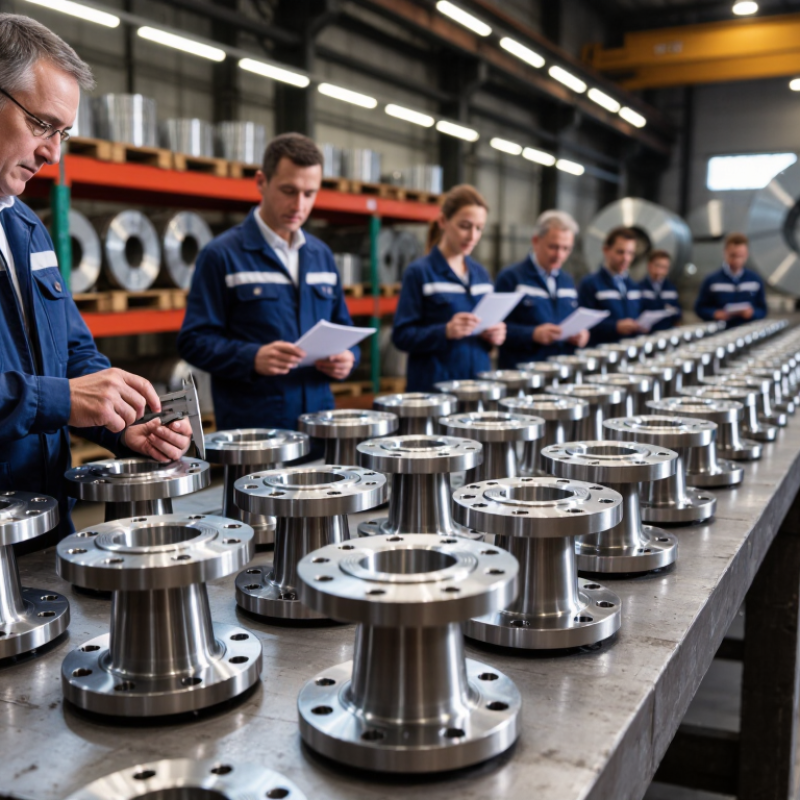
Choosing among ten joint flange manufacturers calls for evidence, not polished catalogs. Ask for material test reports, dimensional inspection records, and traceability from billet to finished flange. Check the flange face, bolt-hole alignment, and sealing surface against the drawing. Small deviations matter.
Quality depends on repeatable controls. Request samples from different production batches, then compare measurements and surface finish. Ask how nonconforming parts are isolated and corrected. A clear answer beats a broad promise. When practical, visit the workshop and observe calibration labels, machining queues, and how parts are protected from corrosion. One visit is not proof, though.
Capacity is more than a monthly output figure. Confirm forging capacity, machining hours, typical lead times, and backup plans for urgent orders. Ask for recent delivery performance, not just best-case schedules. Compliance should match the project’s destination and service conditions. Review certificates, inspection plans, and material grades with an independent engineer when risk is high. Verify certificate scope and expiry dates. Don’t assume. Compare all ten suppliers using the same checklist, including communication speed and document accuracy. A manufacturer that admits a limitation may be easier to assess than one promising everything. I would still question whether a low quote includes testing, packaging, and traceable records.
10 Best Joint Flange Manufacturers for Global Buyers: Products and Markets
Joint flange manufacturers serve energy, water, chemical processing, shipbuilding, and general industrial markets. Their catalogs commonly include weld-neck, slip-on, blind, threaded, and lap-joint flanges. Buyers should compare material grades, pressure classes, dimensions, and inspection records—not just price. Fit matters. A flange that misses a pipe specification can delay installation and create costly rework.
Regional demand reflects broader industrial activity, but published figures rarely isolate flange sales. The World Steel Association’s World Steel in Figures 2024 reports 1,888.2 million tonnes of crude steel production in 2023, indicating the scale of the materials supply chain. The International Energy Agency’s Oil 2024 report projected global oil demand at 103.2 million barrels per day in 2024. These figures provide market context, not direct measures of flange demand. Markets differ. For global buyers, assess a manufacturer’s export experience, material traceability, dimensional controls, and ability to provide test documentation. Ask how products are inspected and packed for transport. A broad catalog can help, but it does not prove consistent quality; that distinction deserves closer scrutiny.
Global Sourcing Checks: ISO 9001, EN 10204 3.1, and Traceability Records
For global flange buyers, a quality certificate is only the starting point. ISO’s 2022 Survey recorded more than 1.2 million ISO 9001 certificates across 189 economies. That shows broad adoption, not product quality by itself. ISO 9001 concerns a manufacturer’s quality management system; it does not certify each flange. Ask for the certificate’s scope, issuing body, validity dates, and site address. Check that the manufacturing location and product range match your order.
EN 10204:2004 defines inspection-document types for metallic products. A Type 3.1 certificate should identify the material and report inspection results tied to the supplied batch. Match its heat number to the flange marking, packing list, and purchase order. Look for the steel grade, dimensions, test values, and authorized validation. Small gaps matter. A polished PDF is not proof if its identifiers do not agree.
Traceability needs to survive receiving and later maintenance. The World Steel Association’s World Steel in Figures 2024 reports 1,892.2 million tonnes of crude steel production in 2023, reflecting a vast supply chain where records can become separated from parts. Request a heat-by-heat material list and retain certificates with shipment records. Check that scans are legible and revisions are controlled. I would still flag unclear links, even when the paperwork looks complete. A missing record can be easy to overlook.
Global Flange Sourcing: What EN 10204 Certificates Show
A practical comparison of inspection-document scope for buyers reviewing flange documentation.
The bars indicate whether each document type includes the listed evidence; they are not quality scores. Type 3.1 reports specific inspection results validated by the manufacturer’s authorized representative independent of production. Type 3.2 adds validation by the purchaser’s authorized representative or an inspector designated by official regulations. Also verify that an ISO 9001 certificate is current and covers the supplying site, and that material test records can be traced to the delivered flange and its heat or batch.
Article Source:
Let's Build Together
Contact Us: Call 435-563-3503
-OR- Fill in the form below and we will call you back.