7 Best Grinding Ball Manufacturers for Global Buyers
Grinding Ball procurement can shape mill performance, maintenance schedules, and operating costs. The right choice depends on ore hardness, mill design, operating conditions, and the supplier’s quality controls. There is no universal winner. A ball that performs well in one plant may wear faster in another.
Industry data helps explain why careful sourcing matters. The U.S. Geological Survey’s Mineral Commodity Summaries 2025 estimates global copper mine production at about 23 million metric tons in 2024. That figure signals the scale of ore processing, though it does not measure grinding-ball demand. The International Energy Agency’s Global Critical Minerals Outlook 2024 also examines expanding mineral supply needs. More processing capacity makes reliable consumables an important purchasing consideration.
This guide compares seven manufacturers for global buyers, focusing on material consistency, manufacturing capability, product range, technical support, and export experience. Look beyond quoted price. Ask for documented chemistry, hardness profiles, wear-test methods, and references from mills with comparable operating conditions. A polished specification sheet is useful, but plant data matters more. Supplier rankings also have limits: public performance claims are not always independently verified, and results can differ by ore and mill. Treat this shortlist as a starting point, then validate each option against your own operating records.
Grinding Ball Types, Materials, and Industrial Applications
7 Best Grinding Ball Manufacturers for Global Buyers
Grinding Ball Types, Materials, and Industrial Applications
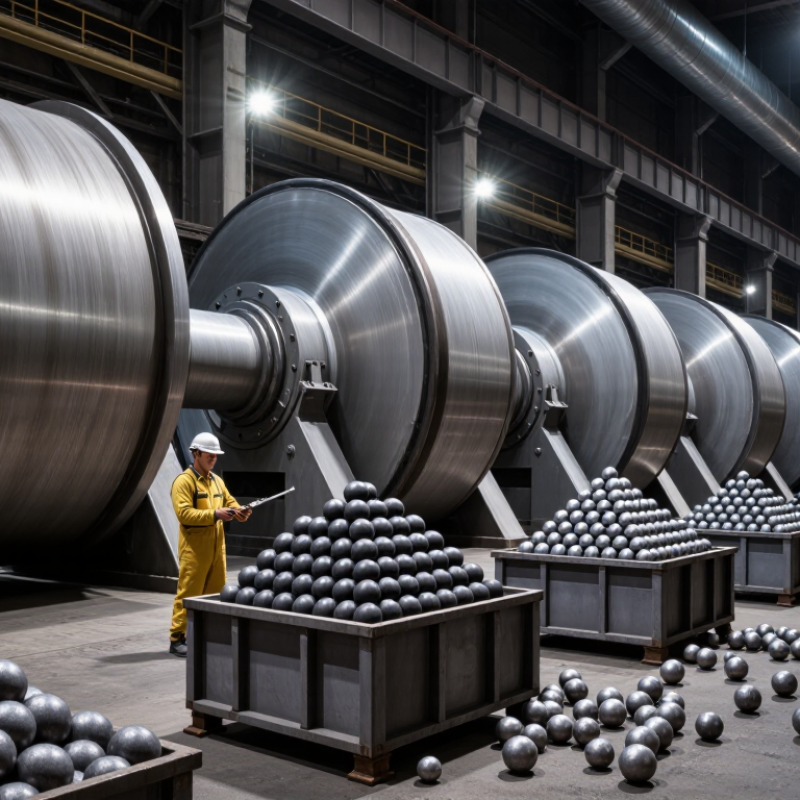
Grinding balls are not interchangeable. Forged steel balls generally suit mills facing heavy impact, while cast steel and high-chrome cast iron balls can fit different wear and corrosion conditions. The right choice depends on ore hardness, mill speed, and ball size—not just the quoted price. Small details matter.
Mining operations use grinding media in ball and semi-autogenous mills to reduce ore before separation. Cement plants also use them to grind clinker into fine powder. The USGS Mineral Commodity Summaries 2024 estimated global iron ore mine production at about 2.5 billion metric tons in 2023, illustrating the scale of mineral processing behind demand for reliable grinding media. Still, production tonnage alone cannot predict ball wear. Ore abrasiveness, water chemistry, and operating conditions all matter.
Tips: Request hardness profiles, chemical-composition data, and impact-test results. Compare wear rates in your own mill, where possible. A high hardness reading can look reassuring, but poor toughness may lead to early breakage. Ask suppliers how they control heat treatment and inspect batches; specifications should be verified, not assumed.
Grinding Ball Materials: Typical Density Comparison
Material density is one factor in choosing grinding media. Denser balls can deliver greater impact energy at the same diameter, while the best choice also depends on the mill, ore, wear conditions, and contamination limits.
Approximate room-temperature material densities; actual values vary by grade, composition, and porosity. Density alone does not determine grinding performance.
Criteria for Evaluating Grinding Ball Manufacturers
Choosing a grinding ball manufacturer requires more than comparing price per tonne. Start with the operating conditions: ore hardness, mill type, feed size, and expected impact load. Ask for documented chemistry, hardness range, and impact or breakage test results. A hard surface can resist wear, but a brittle ball may chip under heavy impacts. Balance matters. Small details matter.
Review how each batch is controlled. Reliable suppliers should explain sampling frequency, heat-treatment controls, and how test records link to production lots. Request recent certificates and, where practical, test a sample in your own mill. Compare wear rate, breakage, and product contamination over a defined period. Results from a different ore body may not predict your performance exactly. That limitation is easy to overlook. Check dimensional consistency, packaging protection, lead times, and the process for handling quality concerns, too.
Tips: Ask manufacturers how they verify results, not only what specifications they offer. Share your mill conditions and request a trial plan with clear measurement points. Keep delivery records and operating data together; otherwise, a poor result can be difficult to diagnose. A polished brochure helps, but it is not proof.
7 Best Grinding Ball Manufacturers for Global Buyers - Criteria for Evaluating Grinding Ball Manufacturers
| Evaluation criterion | What to assess | Evidence to request or check | Why it matters to buyers |
|---|---|---|---|
| Material and grade control | Whether the supplier can specify and consistently produce the requested alloy, carbon content, and manufacturing type, such as cast or forged balls. | Ask for a product specification and batch-specific chemical analysis, such as a spectrometry report. Confirm that the stated grade matches the intended mill and application. | Composition and production route affect wear behavior, toughness, and suitability for different grinding conditions. |
| Hardness and hardness consistency | The specified hardness range and how consistently hardness is maintained within a batch and through the ball section. | Review test reports that identify the test method, sampling location, and applicable hardness scale. Compare results with the agreed specification. | Consistent hardness helps reduce uneven wear and supports predictable grinding performance. |
| Metallurgical structure and defects | The internal structure and the supplier’s controls for casting or forging defects, including cracks, porosity, and excessive segregation. | Request representative metallographic inspection results and the documented inspection procedure. For qualification, arrange independent sampling where practical. | Internal defects can contribute to premature breakage and unplanned mill downtime. |
| Wear and breakage performance | Measured wear and breakage performance under conditions relevant to the buyer’s mill, ore, and operating practice. | Request trial or operating data with the test conditions, ball size, duration, and measurement method stated. Compare suppliers only using equivalent conditions. | Wear results depend on operating conditions, so comparable test details are essential for a meaningful assessment. |
| Dimensional accuracy and product range | Available diameters, dimensional tolerances, surface condition, and the supplier’s ability to meet the buyer’s specified size mix. | Check the current product specification and sample inspection records. Confirm tolerances and acceptance criteria in the purchase contract. | Correct sizing supports the required grinding charge and helps buyers manage replenishment and inventory. |
| Quality assurance and traceability | Documented inspection procedures, batch identification, nonconformance handling, and the scope and validity of any quality-management certification. | Review sample certificates, inspection records, and traceability documents. Verify any claimed ISO 9001 certification with the issuing certification body. | Traceable records make it easier to verify delivered product and investigate quality issues. |
| Export readiness and commercial support | Experience preparing export documentation, protective packaging, shipment plans, and clear technical and after-sales communication. | Ask for a sample packing list and quality document package. Confirm lead time, packaging method, delivery terms, claims process, and technical support arrangements in writing. | Reliable documentation and logistics help protect product during transit and reduce delays at destination. |
Profiles of Seven Grinding Ball Manufacturers for Global Buyers
Grinding-ball suppliers differ less by catalogue claims than by process control, testing, and delivery consistency. The World Steel Association reported 1,888.2 million tonnes of crude steel production in 2023; the US Geological Survey estimated global cement production at about 4.1 billion tonnes that year. Both sectors use grinding media, though these figures describe industrial context, not grinding-ball demand.
The seven supplier profiles buyers can compare include forged-steel specialists, high-chrome cast-ball makers, and low-chrome producers serving cost-sensitive mills. Other profiles focus on custom diameters, integrated foundry operations, regional supply, or export logistics. For each, ask for chemistry certificates, hardness readings, impact-test results, and batch traceability. A sample should match the actual mill conditions, not just a polished brochure.
Small details matter. Review ball-size tolerance, packaging against moisture, and replacement lead times. Ask how suppliers control heat treatment across a full production run; one test result may not represent every batch. A neat catalogue can still hide uneven wear performance. Compare documented test methods and confirm that quoted consumption figures come from comparable ore, mill speed, and operating conditions.
Comparing Product Quality, Production Capacity, and Certifications
A grinding ball’s value is measured in service, not just on a specification sheet. Buyers should compare alloy composition, hardness, and microstructure across sample batches. Ask for test results that show both surface and core hardness; a hard outer layer can hide a softer interior. Wear performance also depends on ore type, mill speed, and operating conditions. Numbers matter.
Production capacity needs practical evidence. A large annual figure says little if delivery dates shift or batch quality varies. Ask how the manufacturer controls furnace temperature, quenching, and dimensional tolerances. Review recent batch records, lead times, and the process for handling out-of-spec balls. A small trial order can reveal more than a polished factory presentation. It may also expose gaps.
Certifications help, but their scope matters. Check that certificates are current, issued to the actual manufacturing site, and relevant to the processes being assessed. Request traceable inspection reports and confirm how complaints are investigated. Independent testing can support these documents, especially when wear costs are high. Still, no certificate guarantees performance in every mill. Buyers should compare evidence against their own operating data, including ball consumption, downtime, and replacement intervals. That comparison takes effort, and the data may be incomplete.
Global Sourcing, Shipping, and Supplier Selection Considerations
Global sourcing of grinding balls is not just a price comparison. Buyers should check the steel grade, chemical composition, hardness range, and impact-test results against their mill conditions. Request recent test certificates and a representative sample; then compare wear in a controlled trial. A polished quotation proves little. Small details matter.
Shipping plans deserve equal scrutiny. UNCTAD’s Review of Maritime Transport 2024 reported that seaborne trade grew 2.4% in 2023, while forecasting 2% growth for 2024. That broader market context does not predict a specific shipment’s arrival, but it shows why buyers should confirm vessel schedules, port options, and buffer stock before placing large orders. Ask suppliers how they protect bags or drums from moisture, prevent load movement, and document each batch.
Supplier selection should include communication and traceability, not only factory capacity. Check whether the producer can share production records, inspection methods, packing lists, and a clear response process for damaged or inconsistent goods. Compare delivered cost, including freight, handling, and possible storage—not just the quoted unit price. Delays happen. A detail worth reconsidering: the cheapest offer may become costly if its shipment plan has no realistic contingency.
Article Source:
Let's Build Together
Contact Us: Call 435-563-3503
-OR- Fill in the form below and we will call you back.