7 Portable Fire Monitor Buying Tips for Buyers
A Portable Fire Monitor can help crews direct a steady water stream where hose handling alone is difficult. Yet choosing one is not just a matter of comparing flow rates. Buyers need to consider the site, water supply, crew size, and expected operating conditions. A unit that works well beside a warehouse may be awkward on uneven ground or in a confined service yard. Small details matter.
These seven buying tips focus on practical checks: rated flow and pressure, monitor range, stability, portability, materials, controls, and maintenance support. Compare manufacturer specifications carefully, and check what those figures mean under real operating conditions. Ask how the monitor connects to your existing hoses and whether one person can move and position it safely. Try the controls with gloves on, if a demonstration is available. Look closely at the base. Will it stay secure on the surfaces your team actually uses?
No single model fits every operation. A high-capacity unit may be unnecessary if the available water supply cannot support it. Conversely, a lightweight design may not suit demanding, prolonged use. That trade-off is easy to overlook. This guide offers a structured way to assess options, identify questions for suppliers, and avoid decisions based only on price or headline performance. Specifications are useful, but they do not replace a site assessment or training by qualified personnel. Some requirements may also differ by application. Check before you buy.
Understanding Portable Fire Monitors and Their Applications
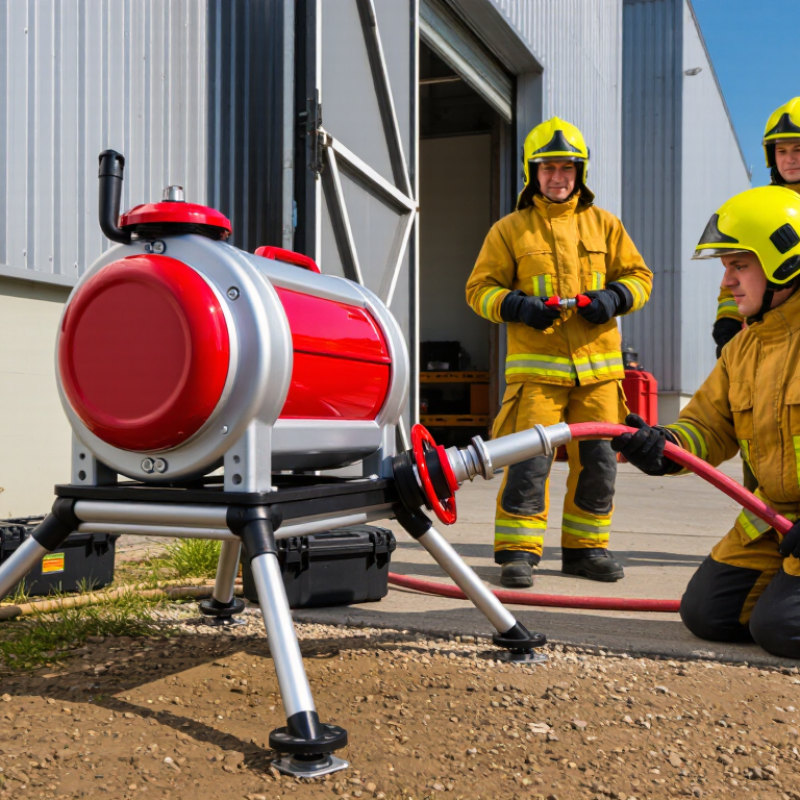
A portable fire monitor is a movable water-delivery device designed to direct a larger, steadier stream than many handheld nozzles. Depending on its design, it may be positioned on a vehicle, a temporary base, or another stable surface. Operators can use it to reach flames from a safer distance or protect exposed equipment. It is not a substitute for an evacuation plan or trained firefighting support.
Applications vary by site. Industrial yards, storage areas, and large outdoor work zones may need a monitor when fire risks cover broad spaces. At a facility, buyers should consider access routes, floor or ground conditions, water supply, and the hazards nearby. A unit that works well on level concrete may be awkward on gravel or beside tightly packed equipment. Details matter.
Check the monitor’s rated flow, operating pressure, adjustment range, connection type, and setup requirements against the site’s actual water system. Confirm that crews can move, anchor, and control it without blocking exits. If foam or another agent may be used, verify equipment compatibility with qualified safety personnel. A catalog rating rarely tells the whole story. I would also ask operators to review the proposed setup in the field; plans can look neat on paper and still feel clumsy in use.
Determining Required Flow Rate, Pressure, and Reach
A portable monitor should be sized around the fire scenario, water supply, and required stream reach—not its maximum-flow label alone. NFPA’s U.S. Fire Loss 2023 report estimated 1,389,000 fires nationwide. That figure is context, not a flow specification. Start by defining the target: a visible point, such as a tank rim or doorway, and the distance and height the stream must cover. Then check the monitor’s flow at its stated inlet pressure. A higher flow demand can exceed the pump or supply capacity.
Pressure drops through hose, fittings, elevation, and bends, so a gauge at the pump may not show pressure at the monitor. NFPA 1964 provides a standardized framework for testing fire-nozzle performance; use comparable test conditions when reviewing published flow and pressure figures. NIST research on wind-driven fires also documents how wind can alter fire conditions and stream behavior. Test the setup outdoors where practical, including the intended hose length and nozzle pattern. Measure the real setup. Note the stream’s useful reach, not just where droplets land. Wind, elevation, and operator position can change results. A common planning mistake is treating catalog reach as guaranteed. It isn’t. Recheck the calculation against the site’s water supply and actual operating conditions.
7 Portable Fire Monitor Buying Tips for Buyers - Determining Required Flow Rate, Pressure, and Reach
Planning guide: the figures below are illustrative selection ranges, not universal product ratings. Confirm the monitor’s approved flow and pressure limits, nozzle performance, hose capacity, and tested stream reach for the exact configuration. Reach varies with nozzle type, elevation, wind, and water conditions.
| Buying Tip | What to Determine | Illustrative Planning Range | What to Check | Why It Matters |
|---|---|---|---|---|
| 1. Match flow to the hazard | Required discharge in gallons per minute (gpm) or litres per minute (L/min). | Portable units are commonly selected across roughly 250–1,000 gpm (950–3,785 L/min); the appropriate flow depends on the hazard and water supply. | Compare the intended flow with the monitor, nozzle, hose, pump, and water-source limits. Use the applicable fire-protection design or incident plan. | A monitor cannot deliver its rated flow if the supply system cannot provide it. |
| 2. Confirm pressure at the monitor inlet | Operating pressure available at the monitor after hose and fitting losses. | About 100 psi (6.9 bar) is a useful comparison point for some equipment, but actual operating requirements vary by nozzle and flow. | Check the pressure-flow curve and maximum working pressure. Calculate or measure losses through the supply hose, elevation, and fittings. | Pump discharge pressure is not the same as pressure available at the monitor inlet. |
| 3. Verify useful stream reach | The distance at which the stream can reach the target with useful water delivery. | Do not rely on a single generic reach figure. Request tested reach data for the selected flow, inlet pressure, and nozzle pattern. | Ask whether the stated reach is theoretical maximum distance or effective reach, and whether it was measured in still air and at a stated elevation. | Wind, stream breakup, nozzle setting, and target height can substantially change practical reach. |
| 4. Size the hose and water supply | Whether the supply line can deliver the target flow while maintaining required inlet pressure. | Compare candidate hose diameters and lengths using an accepted friction-loss method and the hose manufacturer’s flow data. | Include hose length, bends, adapters, elevation gain, pump capacity, and any other appliances operating on the same supply. | Undersized or overly long supply lines can reduce both flow and reach. |
| 5. Check stability and anchoring | Whether the monitor remains secure at the intended flow and operating angle. | Use only the manufacturer’s stated operating limits and anchoring instructions; there is no single safe flow rating for every ground surface or setup. | Review leg or base design, restraint points, surface requirements, reaction-force guidance, and any required safety devices. | Water reaction force can move or overturn an improperly positioned or unsecured monitor. |
| 6. Match the nozzle and stream pattern | Whether a smooth-bore or adjustable-pattern nozzle best suits the task. | Compare flow and reach at the specific nozzle settings intended for use; performance changes when the flow or pattern changes. | Check nozzle compatibility, operating pressure, selectable flow settings, shutoff method, and suitability for the intended agent. | The nozzle is a key part of the flow-pressure-reach system, not an interchangeable afterthought. |
| 7. Assess portability and operating access | Whether the unit can be transported, deployed, and controlled by the available crew. | Compare actual unit weight and packed dimensions with crew capacity, vehicle storage, access routes, and deployment requirements. | Review carrying handles, setup steps, control reach, elevation and rotation range, drainage, and required maintenance. | A monitor that cannot be safely moved or positioned where needed may not deliver practical coverage. |
Comparing Materials, Connections, and Operating Controls
When comparing portable fire monitors, start with the body material and its working environment. Aluminum keeps the unit lighter for vehicle loading and frequent repositioning. Stainless steel may better tolerate corrosive, wet settings, but adds weight. Check the manufacturer’s pressure rating, coating details, and maintenance instructions; material names alone do not prove durability. Look closely at joints and fasteners, where trapped water can encourage corrosion. A few grams matter less than safe handling.
Connections must match the hose, coupling, and available water supply. Confirm thread or coupling type, nominal size, and pressure compatibility before purchase. A mismatch can waste time at the scene. NFPA’s Fire Loss in the United States During 2023 estimated 1,389,000 fires and $23.2 billion in property damage. Those figures do not measure monitor performance, but they underline why dependable setup and flow control matter. Verify connection choices against your actual hose inventory, not a catalog photo.
Operating controls should be usable with wet gloves and under poor visibility. Test the elevation lock, rotation range, shutoff, and nozzle adjustment in person when possible. Controls should move deliberately, without sticking or requiring awkward reach. Ask how the monitor behaves when flow changes, and whether its position remains stable at the rated pressure. I would not assume a smooth showroom demo proves field readiness. Record inspection steps and train operators on the exact configuration.
Evaluating Portability, Stability, and Setup Requirements
7 Portable Fire Monitor Buying Tips for Buyers
Evaluating Portability, Stability, and Setup Requirements
Portability means more than low weight. Check whether one or two people can carry the monitor, hose, and fittings across wet concrete or uneven ground. NFPA’s report Fire Loss in the United States During 2023 estimated 1,389,000 fires nationwide, underscoring the value of equipment that can be deployed without avoidable delays. That figure does not predict a site’s risk, but it does show how frequently fire response is needed.
Stability deserves a hands-on test. A standard nozzle-reaction estimate puts the force near 250 pounds at 500 gallons per minute and 100 psi. Actual reaction varies with nozzle design and operating conditions. Look for secure legs, a wide footprint, and clear instructions for anchoring; don’t assume added weight alone prevents movement. A dry-floor test can flatter a unit. Try a realistic setup on the surfaces your crew may encounter.
Check setup time with the intended crew and hose connections. Can operators unfold the legs, attach the line, and reach controls while wearing gloves? Confirm the required inlet pressure and flow against the site’s water supply, using the monitor’s published specifications. Small details matter. I would still question any purchase decision based only on a brochure: setup often feels different when hoses are charged and space is tight.
Portable Fire Monitor Buying Tips: Flow-Rate Conversion Reference
Use this conversion when comparing monitor flow ratings with available water-supply data. Values are unit conversions, not product specifications; 1 US gallon per minute equals 3.785411784 liters per minute. Also compare unit weight, base footprint, anchoring requirements, and setup procedure before buying.
Checking Certifications, Maintenance Needs, and Total Cost
A portable fire monitor may look simple on a sales sheet, but certification details deserve close attention. Ask for certificates and test reports tied to the exact model and configuration, not just a general product family. Check that the listed standards suit your intended use and local requirements. A label alone is not enough. Confirm who issued the document and whether it remains valid.
Maintenance can shape daily readiness. Look for clear inspection intervals, accessible wear parts, and instructions for flushing the unit after use. Seals, moving joints, and nozzle openings may need regular checks, especially where water contains grit or minerals. Ask how long common replacement parts take to arrive. Small tasks add up. A schedule that seems easy on paper may be missed during a busy shift, so consider who will own each check.
Compare the full cost, not only the purchase price. Include installation, compatible hoses or fittings, periodic service, replacement parts, training, and storage needs. A lighter unit might reduce handling effort but require a different mounting setup; verify this before budgeting. Request a written estimate for routine upkeep and likely wear items. The estimate can still miss something. Leave room for unexpected repairs, and compare suppliers using the same service period and operating assumptions.
Article Source:
Let's Build Together
Contact Us: Call 435-563-3503
-OR- Fill in the form below and we will call you back.